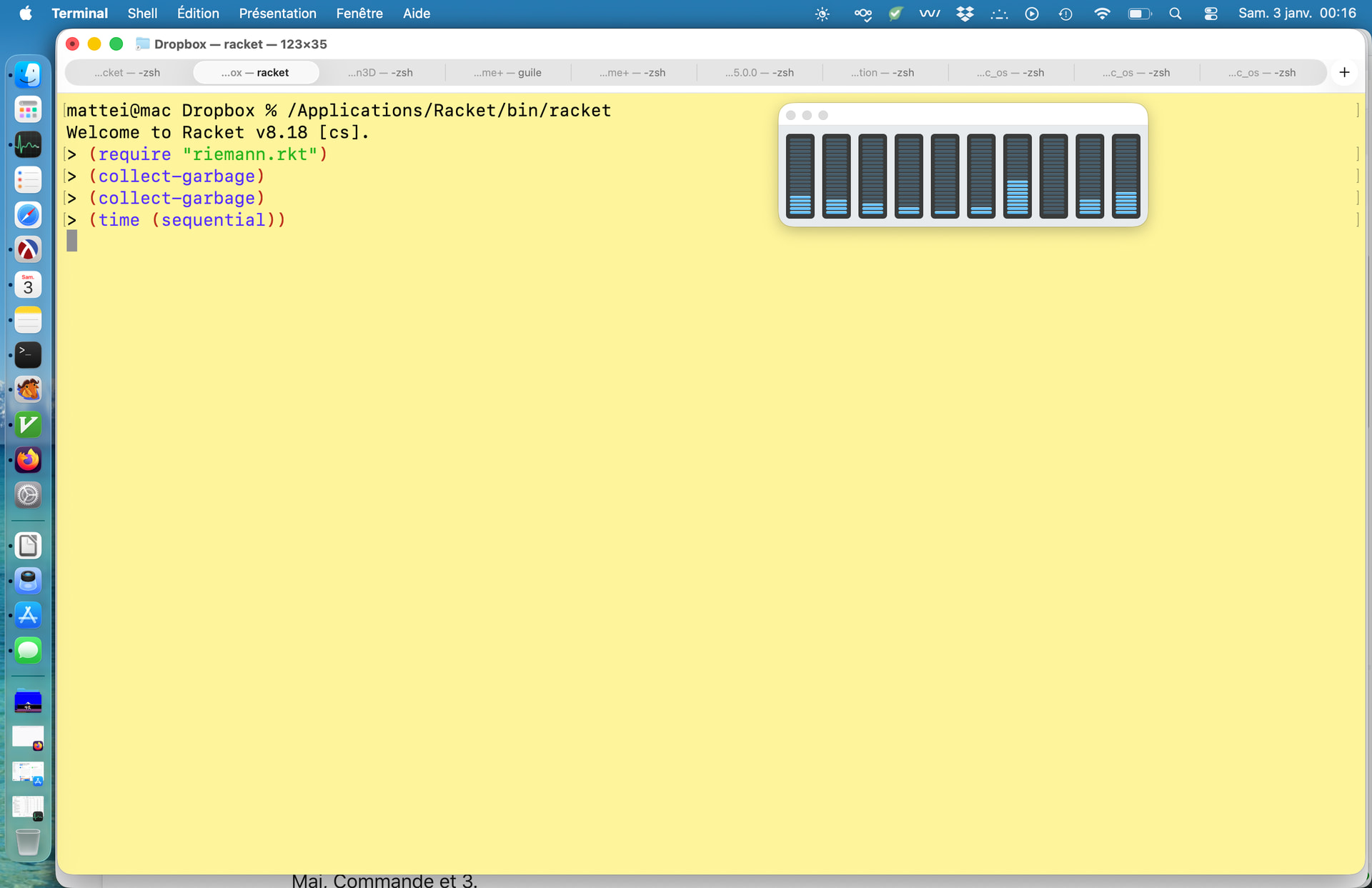
Not so bad with Racket/future in command line interface, compared to C++/Kokkos (OpenMP):
one can see in sequential that 10 cores are lightly used.
in // the 10 cores are heavily loaded.
and the result is faster:
factor >2 but with 10 cores.
Comparing with C++/Kokkos on 1 core:
And with 10 cores,again coresare loaded:
and the speed:
factor of 4 but still with 10 cores.
and approx 3.5times faster than Racket
The code used:
#lang racket

(module+ main


  (printf ";; Sequential:\n")
  (collect-garbage)
  (collect-garbage)
  (collect-garbage)
  (time (sequential))
  (printf ";; Parallel (~v cores):\n" (processor-count))
  (collect-garbage)
  (collect-garbage)
  (collect-garbage)
  (time (parallel)))

(provide sequential
         parallel)

(require racket/flonum
         math/flonum)

(define Function flsin)
#;
(define numSubdivisions 1000000000) ; -> 2.000000000001576
(define numSubdivisions 100000000)  ; -> 1.9999999999999005
;;^  with (sequential), parallel result is 1.9999999999999791
(define A 0.0)
(define B pi)
#;(define dx
  (fl/ (fl- B A)
       (->fl (sub1 numSubdivisions))))

(define dx
  (fl/ (fl- B A)
       (->fl numSubdivisions)))

#;(define init-sum
  (fl/ (fl+ (Function A) (Function B))
       2.0))

(define iter 500)

(define (sequential)
  (define result 0)
  (for ((t (in-range iter)))
    (set! result (fl* (for/fold ([sum 0.0 #;init-sum])
                                ([i (in-range 1 (add1 #;sub1 numSubdivisions))])
                        (define x
                          (fl+ A (fl* dx (->fl i))))
                        (define f
                          (Function x))
                        (fl+ sum f))
                      dx))
    )
  result
  )

(define (parallel)
  (define result 0)
  (for ((t (in-range iter)))

    (define cpus
      (processor-count))

    (define jobs
      (for/list ([job (in-inclusive-range 1 cpus)])
        (future
         (λ ()
           (for/fold ([sum 0.0])
                     ([i (in-range job (add1 #;sub1 numSubdivisions) cpus)])
             (define x
               (fl+ A (fl* dx (->fl i)))) ; A + dx * i
             (define f
               (Function x))
             (fl+ sum f))))))

    (set! result (fl* (flsum ;(cons init-sum
                       (map touch jobs));)
                      dx))
    )
  result
  )
C++/Kokkos :
#include <limits>
#include <cmath>
#include <cstdio>
#include <cstdlib>
#include <cstring>


#include <Kokkos_Core.hpp>


int main( int argc, char* argv[] )
{
  const int N = 100000000;  // nombre de sous-intervalles
  const double a = 0.0;
  const double b = M_PI;
  const double dx = (b - a) / N;
  int nrepeat = 30;  // number of repeats of the test

  // Read command line arguments.
  for ( int i = 0; i < argc; i++ ) {
    if ( strcmp( argv[ i ], "-nrepeat" ) == 0 ) {
      nrepeat = atoi( argv[ ++i ] );
    }
    else if ( ( strcmp( argv[ i ], "-h" ) == 0 ) || ( strcmp( argv[ i ], "-help" ) == 0 ) ) {
      printf( "  riemann Options:\n" );
      printf( "  -nrepeat <int>:        number of repetitions (default: 100)\n" );
      printf( "  -help (-h):            print this message\n\n" );
      exit( 1 );
    }
  }


  Kokkos::initialize( argc, argv );
  {

  // Timer products.
  Kokkos::Timer timer;

  for ( int repeat = 0; repeat < nrepeat; repeat++ ) {
    // Application: riemann integral
    double integral = 0.0;

    Kokkos::parallel_reduce( "RiemannIntegral",
			     N,
			     KOKKOS_LAMBDA ( int i, double &local_sum ) {
			       double x = a + i * dx;
			       local_sum += Kokkos::sin(x); //std::sin(x);
			     },
			     integral );

    integral *= dx;

    // Output result.
    if ( repeat == ( nrepeat - 1 ) ) {
      printf( "  Computed result for Integral is %lf\n", integral );
    }

  }

  double time = timer.seconds();

  // Print results (problem size, time and bandwidth in GB/s).
  printf( "  N( %d )  nrepeat ( %d ) time( %g s ) \n",
          N, nrepeat, time );


  }
  Kokkos::finalize();

  return 0;
}
If i test it on may Linux box:
My Linux Intel7 box seems really slower than Apple M4 even with the 16 cores,and only in // it can save the game a little:
with a factor speedup of 6 with the 16 cores , this is not really what i expected from //.
Let see with C++/Kokkos if it performs better? :
can see it runs well on 16 cores
More than half the time of Racket ,i expected better from C++/Kokkos
The serial run on only one cpu give this time:
About all the articles about computer architecture we can find on the net, i admit it is a bit confusing.I think there is a gap between the guys that do the CPU architecture, and the ones who wrote compilers, and at last the programmers. A lot of times I can personnally hardly find what concretely i can do of all those informations.
"But building programmable hardware that only 5 people in the world can program ain’t a winning strategy, I’d humbly suggest." (from linked article)